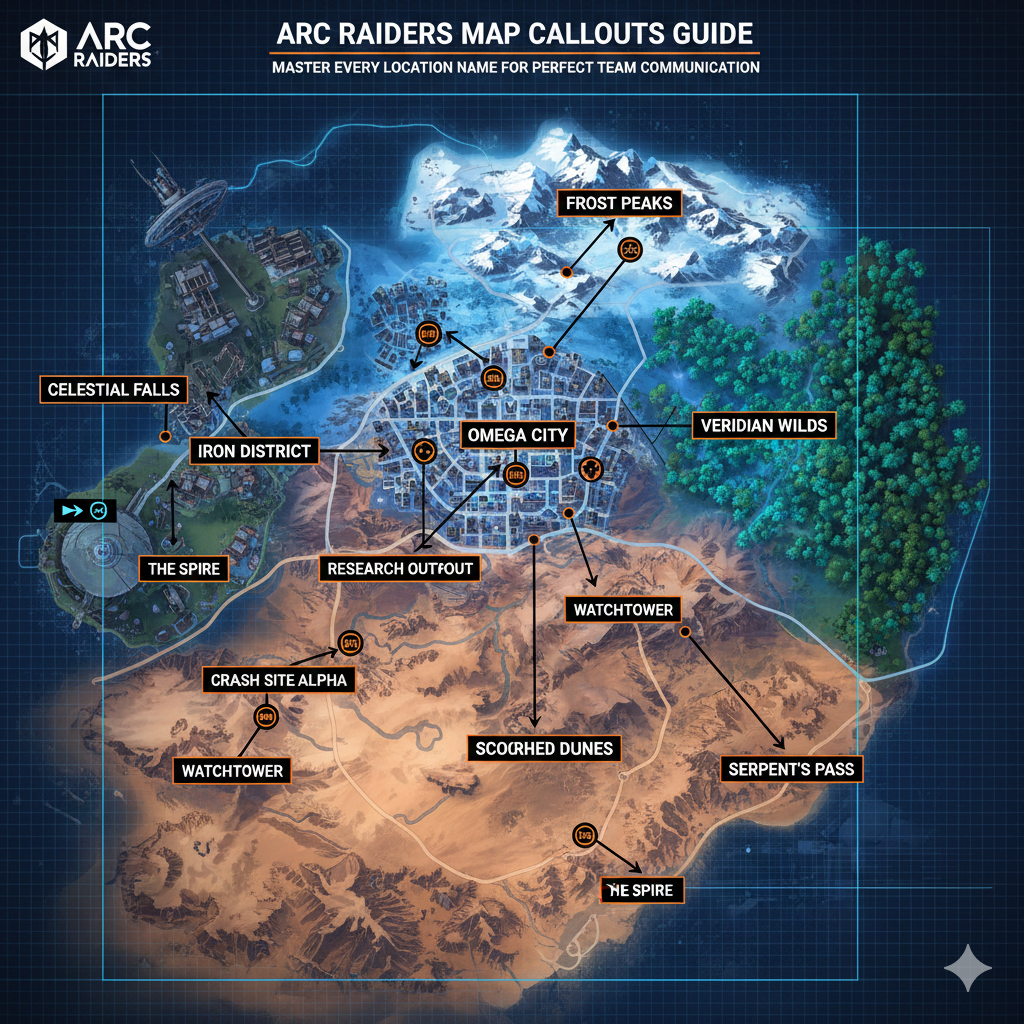
When bullets are flying and ARC machines are closing in, clear communication can be the difference between a successful extraction and a total squad wipe. In ARC Raiders, knowing the exact names of locations is not just helpful—it is essential for survival.
This comprehensive guide will teach you every important callout across all five maps. Whether you are coordinating with your squad, marking enemy positions, or planning your rotation, these location names will help you communicate like a professional raider.
Why Map Callouts Matter
Imagine this situation: your teammate spots enemies but only says “they are over there.” Your squad has no idea where to look. Precious seconds are wasted. By the time you figure it out, your team is already under fire.
Now imagine this: your teammate says “two enemies at Control Tower, second floor, northeast window.” Everyone instantly knows the exact location, direction, and threat level. Your squad can respond immediately with coordinated fire.
Effective navigation requires developing strong map reading skills and environmental awareness, with major landmarks becoming the foundation for all navigation decisions. The best raiders always use specific location names instead of vague directions.
For detailed interactive maps with every location marked, visit ARC Raiders Maps to explore all POIs, loot spots, and tactical positions.
How to Use This Guide
Each map section below lists the major Points of Interest (POIs) that you need to know. Learn these names, practice using them in raids, and soon they will become second nature to your team communication.
Cardinal directions like North, South, East, West form the foundation of all callouts, and should always specify direction relative to map orientation, not your current facing direction.
Dam Battlegrounds: Industrial Warfare Zone
Dam Battlegrounds is the first map most raiders encounter. It features a central dam structure surrounded by industrial complexes, research facilities, and dangerous swampland. The map design creates a natural funnel toward the center, making callouts critical for avoiding ambushes.
Primary Callouts
Control Tower This is the most contested spot on the entire map. The Control Tower sits in the center and offers high-tier military loot. When calling out this location, specify which floor or side you are referencing. Examples: “enemies pushing Control Tower ground floor,” “sniper on Control Tower roof,” or “clear to loot Control Tower east entrance.”
Hydroponic Dome Complex Located in the northwest section of the map, this glass-dome structure is instantly recognizable. The complex contains multiple domes with nature, industrial, and security loot. Call out specific dome numbers if your squad assigns them, or use cardinal directions like “west dome” or “center dome.” This area is a frequent PvP hotspot and popular quest location.
Water Treatment This facility sits near the center-south area and features an extraction elevator, making it a critical reference point. Call out “Water Treatment Control” when referencing the main building, or “Water Treatment extraction” when marking the elevator zone. This is where many teams converge before extracting.
Research and Administration These are two separate buildings but often referenced together because of their proximity. Research sits slightly north of Administration. Both contain valuable loot and weapon cases. Specify which building when making callouts to avoid confusion.
Dam Complex The massive dam structure itself dominates the eastern side of the map. This includes the dam walls, dam top, and dam interior sections. Always specify which part of the dam you are referencing because it spans a huge area with multiple levels and entry points.
Red Lakes A general zone reference for the area surrounding the dam and water features. This is useful for broad positioning updates like “moving toward Red Lakes” or “spotted enemies near Red Lakes area.”
Electrical Substation A smaller landmark in the northeast that serves as an excellent reference point for nearby loot spawns and rotation paths. Often called just “Substation” for short.
Power Generation Complex Located in the northern section, this industrial area contains machinery, containers, and loot boxes. Use this callout when approaching from northern spawn points.
Pipeline Tower This vertical structure offers excellent scouting positions and occasional weapon cases. Call it out when marking elevated threats or recommending high-ground positions.
South Swamp Outpost The southern extraction area that includes swamp terrain and small structures. This is both a callout for positioning and a common extraction reference.
Formakai Hills Rolling terrain in the southern section that provides natural cover and safer rotation routes away from the central funnel.
Dam Battlegrounds Communication Tips
The map forces players toward Control Tower and Water Treatment. Use elevation callouts constantly—”high ground near Dam,” “low in swamp,” or “Pipeline Tower roof.” Elevation references like High, Low, Up, Down indicate vertical positioning differences and are critical for coordinating multi-level engagements.
When rotating, always communicate your path to avoid splitting the squad. Examples: “rotating from Hydroponic to Control Tower via west route” or “extracting to South Swamp, moving through Formakai Hills.”
Check out the Dam Battlegrounds Interactive Map for visual layouts of all these locations.
Buried City: Desert Urban Combat
Buried City is characterized by sand-covered architecture, tight alleyways, and multi-story buildings. This map excels for stealth gameplay and close-quarters combat. The narrow streets create deadly chokepoints, making precise callouts absolutely essential.
Core Location Names
- Plaza Rosa (Piazza Rosa) The major central hub in the southern part of the map. This plaza is a massive PvP arena where multiple squads often collide. When calling this out, specify which side or entrance because the plaza has multiple access points. Example: “three enemies entering Plaza Rosa from north side” or “taking position at Plaza Rosa fountain.”
- Red Tower A critical landmark for navigation and the focus of the “Communication Hideout” quest. The Red Tower is located in the southern portion of Buried City and is a relatively safe area, though raiders sometimes pass by to check for Security Breach rooms beneath the tower. Call this out as “Red Tower base,” “Red Tower roof,” or “Red Tower courtyard” depending on position.
- Hospital A large multi-story building with numerous rooms, hallways, and medical loot. The Hospital is complex, so use floor numbers and cardinal directions in your callouts. Examples: “enemies Hospital second floor east wing” or “looting Hospital basement.” This POI appears frequently in rotation paths.
- Town Hall Another significant building that serves as both a loot spot and tactical position. The Town Hall’s central location makes it a common fighting ground. Specify “Town Hall entrance,” “Town Hall interior,” or “Town Hall balcony.”
- Grandioso Apartments Multi-story residential buildings that create unique vertical combat scenarios. These apartments offer excellent ambush positions and rooftop access. Call out specific apartment buildings by their position, like “northwest Grandioso building” or use identifying features.
- Piazza Arbusto A smaller town square area separate from Plaza Rosa. This is often quieter than Plaza Rosa but still contains valuable loot. Use this callout for positioning between major landmarks.
- Space Travel Building Located in the center of the map above Marano Park, this is one of the best loot buildings in Buried City. The building is large, dense with containers, and tied to many quests with weapon cases and blueprints throughout multiple floors. Call out specific floors like “Space Travel sixth floor” or “Space Travel breach room.”
- Morano Park The park area below Space Travel Building that provides some cover and rotation options through the center of the map.
- West Village Houses / Santa Maria Houses Residential area in the western section of the map. These outer houses provide safer looting away from central PvP zones. Call them out as “west houses,” “Santa Maria area,” or reference specific house positions.
- North Morano Station A station building in the northern section with breachable rooms and rooftop access. Specify “Morano Station ground floor,” “Morano Station roof,” or “Morano Station east side.”
Buried City Communication Strategy
The cramped buildings and tight corridors mean a simple callout like “ARC Trooper on the roof to our north!” is infinitely more helpful than “He’s over there!” because sound travels far in the narrow streets.
Always include building names and floor numbers in callouts. Indoor combat is chaotic, and vague directions will get your squad killed. Use specific landmarks like “pushing from Hospital toward Plaza Rosa” instead of just “pushing center.”
For comprehensive location details, explore the Buried City Interactive Map.
Spaceport (Acerra Spaceport): Vertical High-Risk Zone
Acerra Spaceport is defined by extreme verticality, industrial structures, and concentrated high-tier loot. A majestic testament to humanity’s past ambitions, Acerra Spaceport is where the Exodus shuttles once roared into the heavens. This map rewards teams who master height advantages and multi-level callouts.
Essential Spaceport Callouts
Launch Towers The most prominent vertical structures on the map and the primary loot event location. These towers have multiple levels, so always specify height. Callouts include “Launch Tower top,” “Launch Tower mid-level,” “Launch Tower base,” or “Launch Tower zipline.” There are usually multiple launch towers, so assign them numbers or cardinal directions.
Departure Building A large complex in the southwestern area with multiple weapon case spawns and breach rooms. This building has several floors and entrances. Use callouts like “Departure Building southwest roof,” “Departure ground floor,” or “Departure second floor breach.”
Arrival Building Similar to Departure Building but in a different section. Specify which building to avoid confusion, especially during heated firefights.
Control Tower A6 A busy hotspot that attracts both players and ARC machines. This tower is separate from Launch Towers and serves as a critical tactical position. Call out “A6 base,” “A6 observation deck,” or “A6 stairwell.”
Container Storage A complex maze of shipping containers providing excellent cover but confusing navigation. Use cardinal directions heavily here—”Container Storage north section,” “Container Storage center,” or “Container Storage south entrance.”
Rocket Assembly A key industrial POI with manufacturing equipment and loot spawns. Call this out when rotating through industrial sections or marking enemy positions near large machinery.
Fuel Lines The industrial trench area west of Launch Towers. This is often overlooked but contains valuable weapon crate spawns. Call out “Fuel Lines center pipe area” or “Fuel Lines west section.”
Vehicle Maintenance Located between Fuel Lines and Control Tower A6, this building offers blueprint spawns and breachable rooms. Use “Vehicle Maintenance interior” or “Vehicle Maintenance garage bay.”
Hidden Bunker A map-unique event location that appears in certain raids. When active, this becomes a high-value callout for coordinating team approaches.
Spaceport Vertical Callouts
Because of extreme verticality, always include elevation in Spaceport callouts. Examples: “enemies zipline approaching Launch Tower top from east,” “two ARCs patrolling Rocket Assembly ground level,” or “sniper on Container Storage crane.”
Keep callouts short and relevant: enemy positions, ARC types, and loot locations only, using pings for marking enemies, loot, or routes—especially useful when voice chat is crowded.
Visit the Spaceport Interactive Map to study vertical pathways and zipline routes.
The Blue Gate: Open Wilderness and Underground Bunkers
Blue Gate is known for wide-open spaces, mountainous terrain, and complex underground facilities. The map features massive open areas crawling with ARC enemies across wide fields and mountains. This map requires longer-range callouts and careful underground navigation.
Major Blue Gate Locations
Reinforced Reception The main entrance area and primary PvP action zone. This location typically leads to underground sections. Callouts should specify “Reception entrance,” “Reception lobby,” or “Reception perimeter.”
Central Underground Bunker The most valuable area on the map with red-tier loot floors. The bunker has multiple levels, so specify depth. Use callouts like “bunker upper level,” “bunker lower red floors,” “bunker main tunnel,” or “bunker side entrance.” The bottom floors hold the best loot but are the most dangerous.
Village A smaller settlement area on the surface that provides safer looting and rotation options. Reference this when moving between major landmarks.
Ancient Fort A distinct surface landmark with stone walls and elevated positions. Use this for positioning callouts like “rotating past Ancient Fort” or “enemies fortified at Ancient Fort walls.”
Pilgrim’s Peak A key callout point in the mountainous terrain. This high-ground position offers excellent sightlines. Call it out for sniper positions or long-range threats.
Locked Gate A map event location that often requires puzzle-solving or key items to access. When active, this becomes a priority callout for coordinating team approaches.
Highway Collapse A quest location that contains additional loot opportunities. Call out “Highway Collapse bus area,” “Highway Collapse east side,” or “Highway Collapse underpass.”
Blue Gate Distance and Direction
Because of wide-open spaces, distance estimation is critical. Use meter callouts when possible—”enemies approximately 200 meters northeast of Village” or “rotating 150 meters to Bunker entrance.”
Always provide compass bearings for outdoor engagements: “contact bearing 270, near Ancient Fort” gives precise directional info that your squad can immediately use.
The Blue Gate Interactive Map shows all surface and underground connections.
Stella Montis: Mountain Research Facility
Stella Montis is a late-game map located deep within a mountain facility. This underground complex features tight corridors, multiple levels, and challenging AI encounters. The map demands precise callouts because of its maze-like structure.
Critical Stella Montis Callouts
Medical Research Area A high-traffic PvP zone with valuable medical and tech loot. This area has multiple rooms and corridors. Use callouts like “Medical Research main hall,” “Medical Research west wing,” or “Medical Research containment room.”
Assembly Workshops Known for frequent epic-tier item spawns, this area is a primary loot target. Call out specific workshop sections or use cardinal directions—”Assembly north workshop,” “Assembly rocket thruster area,” or “Assembly center bay.”
Loading Bay A major open area where the Bastion ARC enemy frequently patrols the lower section. This is both a tactical chokepoint and navigation hub. Specify “Loading Bay upper platform,” “Loading Bay lower section,” or “Loading Bay east entrance.”
Lobby The calmer central area that many players overlook. This provides a reference point for other locations. Use “Lobby center,” “Lobby west corridor,” or “Lobby extraction approach.”
Security Checkpoint A multi-level breachable area on the east side of Lobby with four floors of containers. Specify floors when calling this out—”Security Checkpoint third floor,” “Security Checkpoint ground entrance,” or “Security Checkpoint top floor.”
Stella Montis Navigation Tips
The metal floors carry sound extremely far in this enclosed facility. Clear information allows your team to react instantly, coordinate their fire, and stay one step ahead of the enemy. When making callouts underground, include both location and direction of movement.
Examples: “enemy footsteps in Medical Research moving toward Assembly,” “Bastion patrolling Loading Bay lower, heading east,” or “security breach in Assembly northeast workshop.”
Explore the Stella Montis Interactive Map to master the facility layout.
Universal Callout Principles
These communication principles work across all maps and will dramatically improve your squad coordination.
The CLEAR System
C – Concise: Keep callouts short and direct. “Two enemies Control Tower roof” beats “I think maybe I saw a couple of people up on the roof of that tall building in the middle.”
L – Location: Always include a specific place name. “Hospital” is better than “that big building.”
E – Enemy Count: Specify how many threats. “Three ARCs” gives your team tactical info.
A – Action: State what is happening. “Pushing,” “camping,” “looting,” or “retreating” tells your squad what to expect.
R – Relative Position: Add direction when possible. “Northeast of our position” or “behind us at Plaza Rosa.”
Cardinal Direction Mastery
Always orient yourself using the map’s compass system and develop the habit of checking direction regularly, especially after engagements or when moving through complex terrain.
Open your map frequently to verify north. Your screen direction changes constantly, but map north never does. Train yourself to think in map coordinates, not screen directions.
Use compound directions for precision: “enemies northeast of Hospital” is more specific than “enemies north of Hospital.”
Elevation Callouts
In multi-level environments, height difference can mean life or death. Always include vertical position:
- “Enemies above us on Launch Tower”
- “ARCs below in bunker lower level”
- “Sniper elevated position, Dam Complex roof”
- “Ground level threats at Container Storage”
Ping System Integration
Use pings for marking enemies, loot, or routes—especially useful when voice chat is crowded. Pings provide visual confirmation of your verbal callouts.
Combine voice and ping: “Pinging weapon case at Hydroponic west dome” gives both audio and visual reference.
Team Position Updates
Team positioning requires regular updates on team member locations and status, with callouts like “Team spread thin,” “All players accounted for,” or “Need backup at position” to maintain tactical awareness.
Before splitting up, establish rally points: “If separated, regroup at Water Treatment extraction.” This prevents confusion during chaotic fights.
Resource Communication
Resource status communication about ammunition, health, and equipment with callouts like “Low ammunition,” “Medical supplies needed,” or “Equipment damaged” helps coordinate resupply and support.
Share critical information early. “I am low on ammo, need to loot before next fight” lets your squad adjust tactics.
Practice Drills for Learning Callouts
Learning location names takes deliberate practice. Here is how to build callout muscle memory:
Solo Exploration Runs
Load into maps with a free loadout purely for exploration. Visit every major POI and say the location name out loud as you arrive. This builds mental associations between the physical location and its callout name.
Take screenshots at each landmark and label them. Review these images before your next play session to reinforce memory.
Squad Callout Practice
Start by playing exploration matches focused solely on map familiarization, using community resources and guides to learn standard terminology, then practice callouts during low-stakes matches.
Run practice raids where one squad member calls out every location they visit. Other teammates confirm by repeating the callout. This builds shared vocabulary.
Recording Review
Recording your own matches and reviewing communication can help identify areas for improvement. Watch your gameplay and note where vague callouts caused confusion or delays.
Listen for phrases like “over there,” “that place,” or “the thing.” Replace these with specific location names in future raids.
Callout Cheat Sheets
Create reference cards for each map with major location names. Keep them visible near your screen during early learning phases. As you memorize locations, gradually remove the references.
For a complete visual reference, bookmark ARC Raiders Interactive Maps and keep it open on a second monitor or mobile device during raids.
Advanced Communication Techniques
Once you have mastered basic callouts, these advanced techniques will elevate your team to elite coordination levels.
Anticipatory Callouts
Predict enemy movement and communicate it: “If they are leaving Control Tower, they will probably rotate to Water Treatment for extraction.” This prepares your squad for likely encounters.
Threat Priority Callouts
Not all callouts are equally urgent. Use tone and word choice to convey priority:
- Critical: “BASTION LOADING BAY LOWER, FOCUS FIRE NOW!”
- Important: “Three raiders pushing Medical Research from west”
- Informational: “Loot marked at Hydroponic Dome”
Tactical Silence
Sometimes not talking is the best communication. Establish “silent approach” signals for stealth situations. Save callouts for actual contact to avoid giving away your position.
Post-Combat Callouts
After firefights, immediately communicate status: “I am hit, need healing,” “Reloading,” or “Clear, securing loot.” This prevents chaotic looting and accidental friendly fire.
Extract Coordination
The final moments before extraction are often the most dangerous. Use specific callouts for extraction security:
- “Clearing extraction zone at Water Treatment”
- “One minute to extraction, forming defensive perimeter”
- “All players to extraction, moving together from Hospital”
Map-Specific Callout Shortcuts
Experienced raiders develop shorthand for frequently-used callouts:
Dam: “Tower” for Control Tower, “Hydro” for Hydroponic Dome Complex, “WT” for Water Treatment
Buried City: “Plaza” for Plaza Rosa, “Red” for Red Tower, “Hosp” for Hospital
Spaceport: “Launch” for Launch Towers, “A6” for Control Tower A6, “Dep” for Departure Building
Blue Gate: “Bunker” for Central Underground Bunker, “Fort” for Ancient Fort, “Peak” for Pilgrim’s Peak
Stella Montis: “Med” for Medical Research, “Assembly” for Assembly Workshops, “Bay” for Loading Bay
Only use shorthand with regular squadmates who understand your terminology. With random teams, stick to full location names for clarity.
Common Callout Mistakes to Avoid
These errors undermine team communication and lead to failed extractions:
Mistake 1: Screen Direction Instead of Map Direction Wrong: “Enemy to my left” Right: “Enemy west of Hospital”
Your left changes constantly. Map directions stay fixed.
Mistake 2: Vague Location References Wrong: “They are over there by that building” Right: “Two enemies at Grandioso Apartments, northwest building, second floor”
Specificity saves lives.
Mistake 3: No Enemy Count Wrong: “Contact at Control Tower” Right: “Three enemies at Control Tower, ground floor east entrance”
Count lets your squad assess threat level.
Mistake 4: Delayed Callouts Make callouts immediately when you spot threats or locate valuable loot. Delayed information loses value every second.
Mistake 5: Talking Over Teammates Wait for breaks in communication before adding information. Overlapping callouts create confusion instead of clarity.
Mistake 6: Forgetting Vertical Position In multi-level maps, “enemies at Launch Tower” is useless. “Enemies Launch Tower top level” enables proper response.
Building Team Callout Culture
The best raider squads develop consistent callout habits through shared practice and feedback.
Establish pre-raid communication checks. Before dropping into any map, confirm everyone knows the plan and major callout names.
Create a callout feedback loop. After raids, discuss communication successes and failures. What callouts worked? What caused confusion?
Standardize terminology within your regular squad. If you always call the Hydroponic Dome Complex “Hydro,” everyone knows exactly what that means.
Be patient with new players learning callouts. Gently correct location names and reinforce proper terminology through positive examples.
Celebrate good callouts. When a teammate makes a perfect callout that leads to successful engagement or extraction, acknowledge it. This reinforces excellent communication habits.
Final Thoughts: Communication Wins Raids
Map knowledge is absolutely critical for success in ARC Raiders, with players who have strong map awareness consistently achieving higher extraction rates, acquiring more valuable loot, and surviving longer in hostile territory.
But knowledge without communication is just individual skill. True squad power comes from shared awareness through perfect callouts.
Every location name you learn is another tool for keeping your team alive. Every precise callout is a tactical advantage over squads who communicate in vague directions and uncertain positions.
Start with Dam Battlegrounds to build your foundation. Master the core locations on each map. Practice with your squad until callouts become automatic reflexes rather than conscious effort.
The raiders who extract successfully are not always the ones with the best aim or the fastest reflexes. They are the ones who communicate with crystal clarity, who give their teammates the exact information needed at the perfect moment.
Learn these callouts. Practice these communication principles. Transform your squad into a coordinated tactical unit.
For complete interactive maps with every location, landmark, and tactical position marked, visit ARC Raiders Interactive Maps and start mastering your callout game today.
Now get out there, communicate clearly, and make it to extraction. Your squad is counting on you.